Does Neighbours really represent Australia?
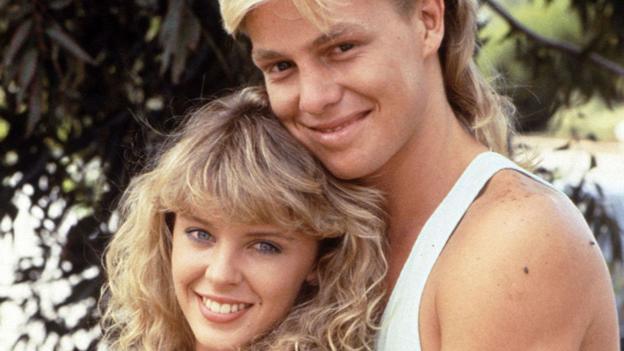
The romance of Scott and Charlene obsessed viewers in the late 1980s and their wedding was the Australian TV event of the decade (Credit: FremantleMedia/Rex)
Australia’s longest-running television series, Neighbours – which helped launch the careers of superstars including Kylie Minogue, Guy Pearce and, Margot Robbie – celebrates its 30th anniversary this week. Every weeknight, viewers around the world from Brisbane to Birmingham tune in for half an hour to the misadventures, intrigues and love affairs that abound in the fictional Melbourne suburb of Erinsborough. But its influence is greatest at home: Neighbours has been an important staple of the Australian television industry for decades.
Well, that last part isn’t strictly true. But with the exception of a handful of token characters (many of whom have never lasted very long), Ramsay Street seems to exist as a sort of antithesis to an ethnically diverse modern Australia whose history has been defined by the tensions between Aboriginal land rights, multicultural migration and white supremacy
The city of Melbourne Make money from your Website or Blog with BidVertiseritself has grown out of four main waves of migration, the first two dispossessing and displacing the Aboriginal people from the Kulin nation. In the 20th Century, war became the driving factor behind migration, and large waves of refugees arrived from Europe, Vietnam and Cambodia. By 1976, nine years before the first episode of Neighbours screened, 20% of the city’s population spoke a first language other than English
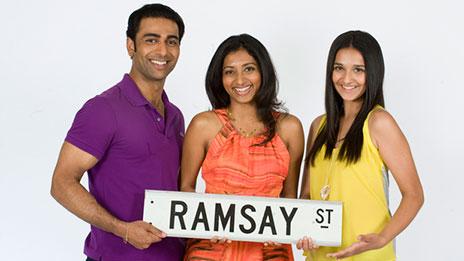
The presence of the Indian Kapoor family was the subject of negative feedback from audiences, according to actor Sachin Joab (Credit: FremantleMedia)
The Kapoors had been introduced to Ramsay Street by previous producer Susan Bower after critics complained that an unofficial ‘White Australia’ policy was in place behind the scenes at Fremantle Media (Neighbours’ production company). But after Bower’s exit from the job, the decision was made to write the Kapoors out. They had been members of the cast for just a year. According to Joab, the new producers argued that the death of Priya Kapoor in an explosion meant there was now a lack of storylines for the husband and daughter she’d left behind. The Kapoors were sent to India to ‘visit a sick relative’ and promptly replaced with yet another Anglo family.
One-way street?
The Kapoors aren’t the first culturally diverse family to ‘fail to thrive’ in the homogenous Neighbours environment. After similar accusations of whitewashing plagued producers in the early ‘90s, the Lim family was introduced. Thwarted by a combination of terrible storylines (including one where the family was accused of eating one of the resident’s missing dog) and even worse acting, the Lims were packed up after a mere six weeks. In 2009, there came Korean exchange student Sunny Lee (played by Hany Lee, again after criticism that the show was too white). And Sunny Lee might have worked had she not also been written as one of the most annoying characters to grace the streets of Erinsborough.
Perhaps part of the problem with writing believable, complex ethnic characters lies in the whiteness of casting agencies and writers rooms. Writers may have the best of intentions, but when the majority of a show’s storyliners are white themselves, the construction of characters can become an exercise in racial stereotyping rather than diversity. Additionally, producers can decide to whitewash storylines or eradicate them altogether. In a 2012 feature in the Sydney Morning Herald, producer Penny Chapman explained that network executives “play it safe” when casting. “What they aren’t worried about is faces that aren’t white, I think what they’re nervous about is what faces that are not white will say.”
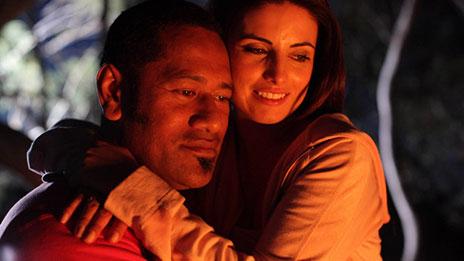
New Zealand-born actor Jay Laga’aia played a new priest in town in rival soap Home & Away – but controversially, his character didn’t last long (Credit: 7 Network)
But why is it assumed that interest in racially diverse characters or their potential for storylines can only be maintained for a finite amount of time? Consider Toadie Rebecchi (played by Ryan Moloney), who’s lived in Ramsay St ever since he arrived in Erinsborough as a teenager. During that time, he’s become a lawyer, had three major romantic relationships and become the adoptive father to a young boy. This year marks Moloney’s 20th year with the show, a monumental feat indeed for an industry that seems to like ‘resting’ its characters once all that can be done with them has been. Sure, Moloney’s character is enormously popular with viewers – but is that because with his white skin and traditionally conservative story trajectory, he poses no threat to an understood order of Australian life?
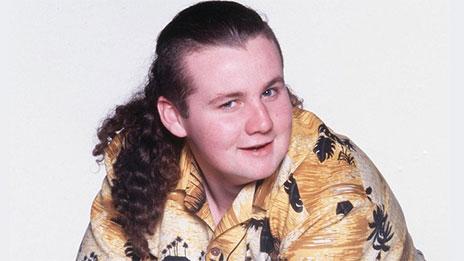
Ryan Maloney’s character Toadfish Rebecchi – seen here in his mid-’90s pomp – has clocked up nearly 20 years on the show (Credit: FremantleMedia)



No comments:
Post a Comment