
Locals have been questioning why security was not heightened. Only two guards were on duty at the time of Thursday's attack.
Meanwhile, al-Shabab has promised a "long, gruesome war" against Kenya.
In a statement on Saturday, it said its attacks were in retaliation for acts by Kenya's security forces, who are participating in the African Union's mission in Somalia against al-Shabab.
Al-Shabab was also blamed for the Westgate Mall attack in the capital Nairobi in 2013, in which 67 people died.
Police in neighbouring Uganda say they have received information suggesting a similar attack is being planned there.
Call for vigilance
In Garissa, four more people have been found alive on the campus, but two are suspects and have been arrested, sources say.One is said to be a Tanzanian national with no known links to the university.
All the bodies have been removed from the scene, Kenya's interior minister Joseph Nkaiserry said. All were students apart from three police officers and three soldiers.
Security services seem to have had information that an attack on an institution of higher learning was likely and appear to have warned such establishments to be careful, the Daily Nation reported.
The University of Nairobi told students on 25 March that it had been warned about a possible attack on a university and asked them to be vigilant, the paper said.
 |
| Many of the students who survived were escorted off the campus to receive counselling |
 |
| Kenyan forces prepared to sweep inside the campus hours after the attack |
 |
| Long queues formed at mortuaries to identify the victims |
Locals in the eastern city of Garissa, 150km (100 miles) from the Somali border, questioned why security was not boosted in light of the intelligence.
"It's because of laxity by the government that these things are happening. For something like this to happen when there are those rumours is unacceptable," said Mohamed Salat, 47, a Somali Kenyan businessman.
One survivor, who hid in bushes during the assault, said the students had raised security issues late last year, but only two armed guards had been provided. Another said the gunmen appeared to know the site well.
Another witness told the BBC she heard the gunman receiving instructions on mobile phones, and speaking in Swahili, an official language in Kenya - raising the possibility the attackers were locals and not from Somalia, al-Shabab's heartland.
A dusk-to-dawn curfew has now been imposed in the area.
In his address to the nation after the attack, President Uhuru Kenyatta said he had instructed the police chief to speed up the training of 10,000 recruits, because Kenya had "suffered unnecessarily" because of a shortage of security personnel.

A second-year student who hid for 10 hours in a wardrobe is one of about 500 survivors still being held at a military facility, where they are undergoing counselling.
Her father drove for four hours from Nairobi when he was unable to get hold of her during the siege.
He told the BBC about his desperate search for his daughter at the mortuary, hospital and military airstrip.
Late in the afternoon, when he had almost given up hope, he got a text: "Dad call me".
Eyewitnesses describe attack
Why is al-Shabab targeting Kenya?
Christians targeted
The masked attackers killed two security guards at dawn on Thursday, then rampaged through campus, shooting and shouting "we are al-Shabab".They singled out Christians and shot them, witnesses said.
While many of the survivors spoke to the media, little is known so far about those who were killed.
The BBC's Frenny Jowi says Kenyan media are cautious in their coverage because of a new anti-terror law that stipulates heavy fines for material "likely to cause fear".
The gunmen were eventually cornered in a dormitory by Kenyan security forces. Four of them died when their suicide vests detonated. A fifth gunman was reportedly arrested.
Al-Shabab, which is linked to al-Qaeda, said it carried out the attack. The group says it is at war with Kenya, which sent troops to Somalia in 2011 to fight the militants.
The Kenyan government has offered a reward of $53,000 (£36,000) for the man it says planned the killing - Mohamed Kuno, a former Kenyan schoolteacher, now thought to be in Somalia.
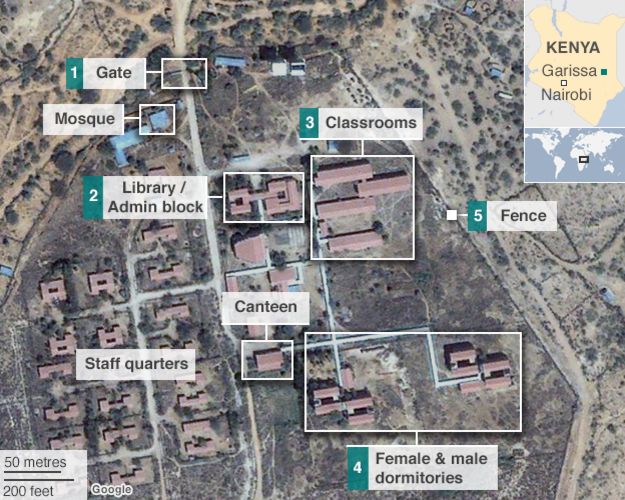
2. Shooting begins within the campus
3. Students attacked in their classrooms while preparing for exams
4. Gunmen believed isolated in the female dormitories
5. Some students make an escape through the fence



No comments:
Post a Comment